
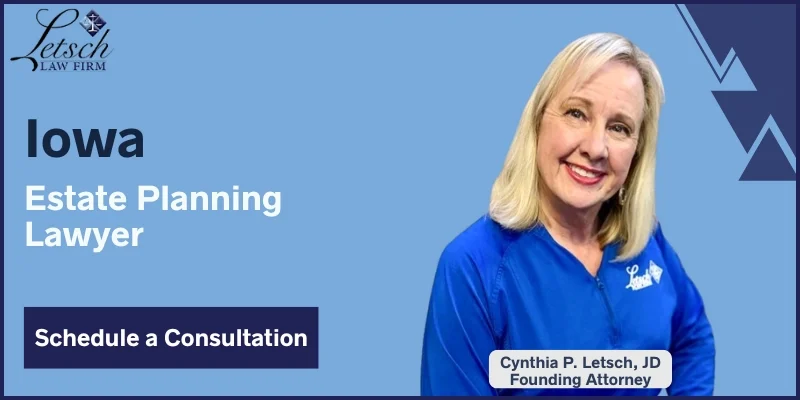
The estate planning choices you make today can ease the burden on your loved ones, both during your lifetime and after you’re gone. Proper estate planning in Iowa helps ensure your wishes are honored after your passing and that your family avoids unnecessary stress and uncertainty. An Iowa estate planning lawyer from our firm can guide you through the estate planning process by explaining your options and tailoring the right estate planning tools to achieve your goals.
Planning for your future requires careful consideration of your financial goals, your family’s needs, and your personal wishes. As you prepare to make important estate planning decisions, Letsch Law Firm can be there to guide you through the process with confidence.
Our lead attorney holds nearly 30 years of experience creating and executing important estate planning documents and tools. As a Certified Medicaid Planner and member of the Iowa Bar Association Probate and Trust Sections, she understands the various financial planning tools that can help you achieve your goals and secure a stable, supportive future for your loved ones.
Estate planning plays an essential role in ensuring that your assets are distributed according to your personal wishes and that your loved ones are spared from unnecessary legal complications. Surprisingly, only 33% of Americans have an estate plan, and just 20% of those include a trust. This leaves millions of Americans potentially unprepared when life changes quickly.
Iowa has approximately 73,129 millionaire households, making asset protection and efficient transfer of wealth a priority for residents across the state. Many of these residents are older, which only emphasizes the importance of having a valid plan in place, as accidents can quickly change their circumstances. According to the Iowa State Data Center, in 2021, there were 25,805 people aged 65 and over in Des Moines. This group is particularly vulnerable without planning.
Estate planning in Iowa often involves the drafting, reviewing, and executing of multiple estate planning tools that collectively work together to protect an estate owner’s properties, assets, and personal wishes. These tools can be executed both during their lifetime and guide agents of their estate after death. Common estate planning tools used by Iowa residents include:
Many Iowa residents opt to use multiple tools at once to build a cohesive estate plan that adequately protects their assets and personal wishes. These tools can protect an estate, reduce family conflict, and safeguard legacies for future generations.
Take the first step in managing your legal affairs by contacting us today.
Call Us Today (515)-986-2810
If you care about how your estate is managed during your lifetime and settled after your death, making the decision to hire an estate planning lawyer should be your top priority. An Iowa estate planning attorney from our firm understands the state’s unique estate planning laws and how to help clients navigate planning their futures with confidence.
Whether you need help setting up a trust, will, or a more complex estate planning tool, our attorneys can handle the complex work of drafting, carefully reviewing, and executing those documents so they are clearly worded and enforceable in court. Our team can also help you interpret existing estate planning documents or represent you through disputes in probate court.
A: Using an attorney for estate planning in Iowa helps ensure wills, trusts, and powers of attorney meet stringent legal requirements and avoid costly errors. Any attempt to self-draft estate planning tools could lead to overlooked tax consequences, Medicaid ineligibility, or invalidity of your wishes. An attorney can tailor strategies that work to protect your assets while meeting your long-term goals and ensure they adhere to all state and federal laws.
A: Under Iowa statute, the maximum that an attorney can charge for a probate estate having gross assets of $200,000 or more (regular estate) at 2% of the gross value of the estate. The gross value is calculated by adding all assets together, except for life insurance paid to a named beneficiary. The gross estate includes retirement accounts and other investment accounts, even if the account has a named beneficiary or is jointly owned with someone else. It’s traditional for Iowa attorneys to charge the maximum 2% fees as a contingency fee. The larger the estate, the higher the fee.
For estates with a gross value under $200,000 (small estate), many attorneys charge by the hour. The amount of time that it takes to probate a small estate is dependent on many factors including the ease or difficulty of identifying assets, claims made by creditors, identifying and locating beneficiaries, settling beneficiary disputes, issues related to liquidating assets, and settling end of life income tax issues.
In general, whether it is a regular or small probate estate, the process from open to close will be 18 to 24 months.
A: An estate planner in Iowa may be a financial advisor who offers guidance on managing assets and tax efficiency. An estate planning attorney, however, is someone who has the legal authority to draft wills, trusts, and related documents. They also have the power to represent clients in probate court when needed. An attorney understands how to help clients plan for the future, whereas financial planners are not licensed to practice law or represent clients in probate court.
A: Estate planning in Iowa should begin as soon as adults acquire assets, start families. While many assume the process is only for retirees, unexpected illness or accidents can occur at any age. Starting early provides both control over how your estate is handled and peace of mind for your future.
A: Every person who turns 18 years of age and has the decision-making capacity to understand that he or she is granting someone the authority to help with decision-making either now or in the event of a life emergency, should sign a general durable power of attorney and a medical power of attorney. There is no law in Iowa that allows your spouse or your parents to manage your affairs or make medical decisions simply because of family relationships.
Once you are an adult, you are presumed to be the only person who can make decisions, unless you have granted that authority to someone else, in writing. You are not giving up any of your own rights to continue making your own decisions by signing a power of attorney. You are simply granting someone else the authority to help you if you need it.
Estate planning is one of the most meaningful steps you can take to protect your loved ones and your legacy in Iowa. Whether your goals include creating a will, setting up one or more trusts, or ensuring that proper powers of attorney are in place, Letsch Law Firm is here to help. We focus on strategies that safeguard your assets while ensuring that your wishes are honored.
Contact our office today to learn how we can help you prepare for the future with confidence and peace of mind.
Fields marked with an * are required
"*" indicates required fields
Copyright © 2026 Letsch Law Firm• All Rights Reserved. Disclaimer | Site Map | Privacy Policy. Digital Marketing By: 
*Images are obtained under license from Canva and other third-party stock image providers, with attribution included where required.